Does a Rolex Take a Battery?
Almost certainly not. If your Rolex ticks once per second, it's either a genuine Oysterquartz — which is rare and valuable — or it's a fake. Here's how to tell the difference.
Almost all Rolex watches are automatic mechanical watches — powered entirely by wrist movement, with no battery, ever. If your Rolex has stopped, it simply needs winding or wearing. There is one genuine exception: the Rolex Oysterquartz, produced from 1977 to 2001. If you don't have one of those, and your watch is ticking once per second like a quartz — it is very likely a fake.
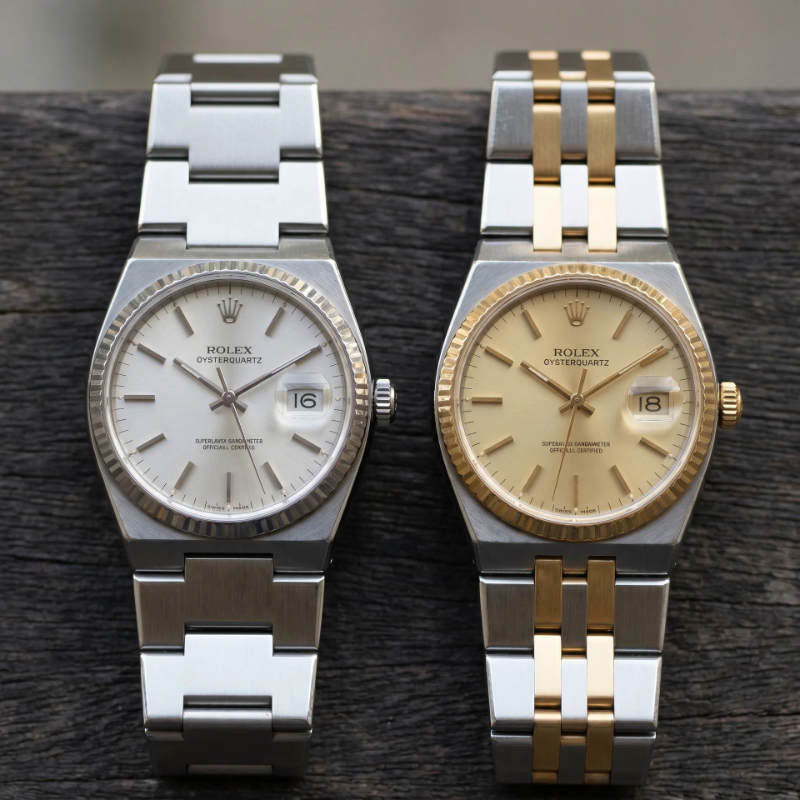
The one genuine exception: the Rolex Oysterquartz
During the 1970s, the Swiss watch industry faced a serious threat from cheaper, highly accurate Japanese quartz watches. Even Rolex felt the pressure and responded with their own in-house quartz movement — one they engineered to their own exceptionally high standards, rather than using an off-the-shelf module. The result was the Oysterquartz.
The two Oysterquartz models
Oysterquartz Datejust
Rolex calibre 5035. The more common of the two. Stainless steel, two-tone, or white gold variants.
Oysterquartz Day-Date
Rolex calibre 5055. Rarer, and now highly collectible. Gold models particularly sought after.
Both movements used Rolex's own proprietary quartz module — not a standard Citizen or ETA movement. The finishing inside is genuinely high-end, which is why the Oysterquartz was accurate to within one minute per year rather than the seconds-per-day accuracy of most quartz watches.
How to recognise an Oysterquartz
The Oysterquartz looks nothing like a typical Rolex. If you're not sure whether you have one, here's what to look for:
The case and bracelet flow together as one piece — sharp, angular links that taper into the case. No gap between case and bracelet. Very distinctive 1970s integrated-bracelet design.
The second hand ticks once per second — the only genuine Rolex that does this. All other modern Rolex watches sweep smoothly at 8 beats per second.
The word "Oysterquartz" is printed below the Rolex crown logo on the dial. There is no ambiguity — Rolex named it clearly.
The Oysterquartz only ever came in Datejust and Day-Date variants. No Submariner, no GMT, no Daytona, no Explorer. Only these two models — ever.
Oysterquartz Datejust references: 17000, 17013, 17014. Day-Date references: 19018, 19028, 19038. If your reference number doesn't match these, it's not an Oysterquartz.
⚠️ If your Rolex ticks once per second — read this
Over nearly 40 years in the jewellery trade, we have had this conversation more times than we can count. A customer comes in with a "Rolex" that's stopped working and needs a battery. We look at it. It's a fake.
Here is the truth: Rolex never made quartz versions of their iconic sport and tool watches. These models do not exist as genuine quartz Rolexes:
- ❌ Rolex Quartz Submariner — does not exist
- ❌ Rolex Quartz GMT-Master — does not exist
- ❌ Rolex Quartz Daytona — does not exist
- ❌ Rolex Quartz Explorer — does not exist
- ❌ Rolex Quartz Milgauss — does not exist
- ❌ Any lady's Oysterquartz — does not exist (Rolex never made a lady's Oysterquartz)
If someone has sold you one of these, or is trying to sell you one, it is a counterfeit. Imitation Rolexes — sometimes called "replica" watches — are widely available and often use cheap quartz movements that tick once per second. That single tick is one of the clearest tells.
Do not take a fake Rolex to an authorised Rolex dealer — they will not service it, they will identify it as a counterfeit, and it will be an awkward situation. Take it to an independent jeweller who can be honest with you about what you have.
There is no shame in this. We see it regularly. People receive watches as gifts, buy them on holiday, inherit them — not knowing what they have. A good jeweller will tell you honestly, without judgement.
The battery for a genuine Oysterquartz
If you have a confirmed genuine Oysterquartz and it needs a battery, here is exactly what you need:
The battery: The Oysterquartz uses an SR44W silver oxide battery (also referred to as 357, 303, or SR44SW depending on the supplier). The Datejust (calibre 5035) and Day-Date (calibre 5055) both use the same size cell.
The battery itself costs a few pounds. That is not the issue.
⚠️ Do not attempt this yourself — unless you are a professional watchmaker
The Rolex Oysterquartz has a proprietary screw-back case that requires a specific professional spanner-style tool to open. It is not a standard push-back or coin-slot case. Without the correct tool, you will damage the case back — and on a watch worth thousands of pounds, that is an expensive mistake.
Beyond opening the case, the water resistance gasket must be replaced and the case must be pressure tested after reassembly. Rolex builds the Oysterquartz to Oyster standards — 100 metres water resistance. Reassembling it incorrectly will compromise that, potentially allowing moisture into a valuable movement.
Take it to a qualified independent watchmaker. This is a routine job for a professional with the right tools — typically a straightforward service visit. You do not need to go to an authorised Rolex dealer for this (they will charge considerably more for the same work), but you do need someone who knows what they are doing with a watch of this calibre.
A word from our watch expert
The Oysterquartz is a fascinating watch that spent decades being overlooked and undervalued. When it was new, people associated quartz with cheapness. When it was discontinued, it was seen as a curiosity. Now collectors have woken up to what it actually is: a very rare, beautifully made Rolex with a story behind it.
We've handled a few over the years. The movement finishing is genuinely impressive when you open one up — exactly what you'd expect from Rolex, not the bare-bones internals of a standard quartz watch. The integrated bracelet is also beautifully machined. These are not lesser Rolexes.
If someone offers you an Oysterquartz at a sensible price, it's worth serious consideration as a collector piece. Especially the gold Day-Date models — they're quite special.
And if someone offers you a "Rolex Submariner quartz" — walk away.
📈 The Oysterquartz collector market
For years the Oysterquartz was one of the most affordable genuine Rolexes on the pre-owned market — overlooked precisely because it had a battery. That has changed significantly. With only around 24,000 ever produced across 25 years of production, these are genuinely rare watches. The integrated-bracelet trend in modern watchmaking (think Audemars Piguet Royal Oak, Patek Philippe Nautilus) has also drawn attention back to the Oysterquartz's design. Stainless steel Datejust models have been trading in the £4,000–£6,500 range. Gold Day-Date examples regularly exceed £10,000–£20,000.
Frequently asked questions
Related pages
Looking for the battery for a different device?
Search all devices on myBatteryFinder →